
Garage Door Expert Guide
Signs Your Garage Door Spring Is About to Break Don't Wait Until It Does
- Updated April 2026
- 18 min read
- Pasadena, CA
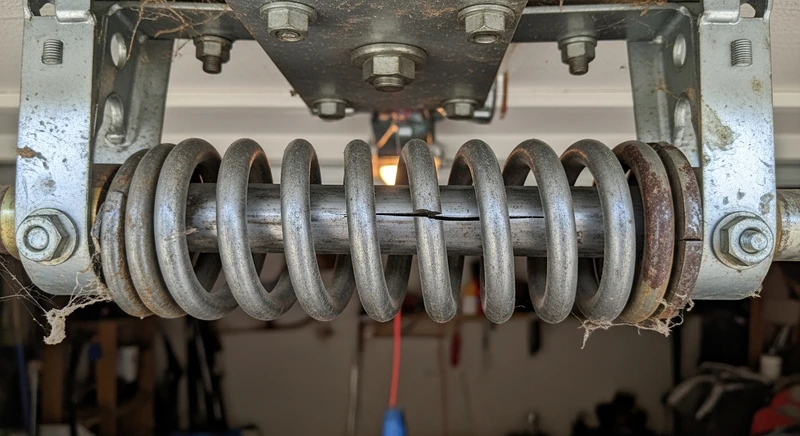
Your spring is holding up 200 to 500 pounds every single time you open that door. When it finally goes — and it will — you want to be the one in control of when and how.
One morning you press the button, hear the motor run, and the door barely moves — or drops four inches and stops dead. That’s your spring. And unlike most home repairs that give you weeks to think it over, a failing garage door spring gives you days, sometimes hours.
Here’s what most homeowners don’t realize: a standard residential garage door weighs between 150 and 500 pounds. Your spring is doing the heavy lifting — literally — every single time that door moves. The opener isn’t moving the door on its own. It’s just guiding a door that the spring is actually lifting. Take the spring out of the equation, and the opener is pushing hundreds of pounds with nothing to help it.
Springs are, by a wide margin, the most common cause of garage door failure in Pasadena homes. Every technician at Garage Door Pros will tell you the same thing: most emergency calls we get could have been a scheduled repair if the homeowner had caught the signs two weeks earlier.
This guide covers every warning sign — the obvious ones, the subtle ones, and the visual ones that most people walk right past. We’ll also tell you exactly what to do based on what you’re seeing, and when waiting is no longer an option.
Pasadena Homeowner: Read This First - If your door has already stopped opening, if you've heard a loud bang, or if you can see a gap in the spring coil — stop using the door immediately. Operating a garage door with a failed spring risks burning out the opener motor, snapping the cables, and in the worst cases, having a 300-pound door drop with nothing stopping it. Call (626) 707-0240 before you attempt anything else.
First, Know What Type of Spring You Have
The symptoms of a failing spring differ slightly depending on which system your garage runs. Before we get into the warning signs, spend thirty seconds identifying which spring type is in your garage. It changes what you look for.
Torsion Springs — The Most Common Type in Pasadena
Look directly above your garage door, along the horizontal metal tube that runs across the top of the opening. If you see one or two tightly wound coil springs mounted on that shaft, you have torsion springs. Most Pasadena homes built after 1990 use this system. Torsion springs store energy by twisting — when the door closes, the spring winds tighter. When it opens, that wound energy releases and lifts the door. When a torsion spring fails, it typically snaps with a loud bang and leaves a visible gap in the coil.
Extension Springs — Common in Older Pasadena Homes
If you see springs running horizontally along the tracks on either side of the door (parallel to the ceiling), you have extension springs. Pre-1990 Pasadena homes, particularly in Bungalow Heaven and older West Pasadena neighborhoods, often still run on this system. Extension springs stretch and contract — rather than twist — as the door moves. They tend to fail less dramatically, but their failure pattern is harder to predict. A worn extension spring often sags, stretches visibly, and gives you more visual warning before it snaps.
TorqueMaster Springs — Hidden Inside a Tube
If your garage door is a Wayne Dalton brand, you may have a TorqueMaster system where the spring is enclosed inside a tube above the door. You cannot see the spring directly. With TorqueMaster systems, the warning signs are almost entirely behavioral — how the door sounds, moves, and feels — rather than visual inspection of the spring itself.
10 Warning Signs Your Garage Door Spring Is About to Break
These aren’t ranked by how common they are. They’re ranked by how urgently you need to act when you see them. Start at the top and work down.
Visible Gap in the Spring Coils
This isn't a warning sign — it's confirmation that the spring has already broken. A healthy torsion spring is wound tightly with no visible space between coils. When it snaps, it partially unwinds and creates a gap, usually one to three inches wide. If you see a gap, stop using the door right now. The spring is done. Every cycle after this point puts the opener motor, cables, and track at risk of secondary damage.
Loud Bang or Popping Noise from the Garage
Homeowners frequently describe a breaking torsion spring as sounding like a gunshot inside the garage — sudden, sharp, and unmistakably loud. It can happen any time: while the door is moving, while it's sitting still, at 2 a.m. Extension springs snap with a similar crack but slightly lower in volume. If you heard a loud bang from your garage and the door now won't open — that was your spring. This is not a "call tomorrow" situation. A popping noise during operation that's softer and repetitive is different — that's a warning sign, not a failure event, and means the coils are beginning to crack under metal fatigue.
Squeaking or Grinding Noise During Operation
This is the sign most homeowners brush off — and it’s the one that costs them the most money when they do. A grinding sound during door movement means coil-on-coil metal friction, which happens when rust builds up inside the coils or when debris gets embedded in the spring. Squeaking alone is often just a lubrication issue. But here’s what’s interesting: if you apply a silicone-based lubricant — never WD-40, which dries out metal and accelerates corrosion — and the noise returns within a week, the spring’s metal has fatigued past the point where lubrication helps. That spring is deteriorating. In Pasadena specifically, Santa Ana wind events push fine debris into garage tracks and spring coils at an accelerated rate. If your grinding noise appeared or worsened after a recent wind event, take it seriously. See our Garage Door Maintenance page for the lubrication steps we recommend between service visits.
Door Feels Extremely Heavy to Lift Manually
Disconnect the opener using the emergency release cord — the red handle hanging from the track — and try lifting the door manually to about waist height. Let it go gently. A properly tensioned spring holds the door at that height without it moving. If the door slides down immediately, the spring has lost significant tension. If it feels like you’re lifting dead weight, the spring may already be broken. Most homeowners can lift a correctly counterbalanced door with one hand. If yours requires two hands and genuine effort, the spring isn’t doing its job. Do this test quarterly. It takes under thirty seconds and tells you more than any visual inspection.
Crooked or Tilting Door
Garage doors with two extension springs — one on each side — can develop a lean when one spring fails while the other keeps working. The functioning side lifts normally; the failed side drags. A door that tilts noticeably to one side is a two-spring failure in progress. It will jam on the tracks. It puts uneven stress on the opener. And it’s telling you plainly that one spring is already gone and the other is carrying the full load — which means the second spring is now under more stress than it was designed for. This accelerates its failure timeline dramatically.
Crooked or Tilting Door
Garage doors with two extension springs — one on each side — can develop a lean when one spring fails while the other keeps working. The functioning side lifts normally; the failed side drags. A door that tilts noticeably to one side is a two-spring failure in progress. It will jam on the tracks. It puts uneven stress on the opener. And it’s telling you plainly that one spring is already gone and the other is carrying the full load — which means the second spring is now under more stress than it was designed for. This accelerates its failure timeline dramatically.
Jerky or Stuttering Movement
A door that moves smoothly is a door with balanced tension. When the spring starts to lose tension unevenly — which happens as individual coils crack or weaken — you get stuttering movement. The door lurches, hesitates mid-travel, or moves in fits and starts. Now, here’s the catch: jerky movement can also come from worn rollers or a bent track, so this sign alone doesn’t confirm spring failure. But combined with any other sign on this list, jerky movement points directly at the spring. It also accelerates damage to your garage door opener — every uneven pull strains the motor’s drive mechanism.
Door Slams Shut or Closes Too Fast
This is a safety emergency, not an inconvenience. Your spring’s job on the way down is to control the descent — providing resistance so the door closes slowly and safely. When that resistance disappears, gravity takes over. A 200-pound door closing with nothing slowing it down is a serious injury risk for anyone walking through or standing beneath it. Children and pets are most vulnerable. If your door is closing faster than it did six months ago — even slightly — schedule an inspection immediately. If it’s slamming, stop using it today and call for service.
Door Won't Stay Open — Slides Back Down
Lift the door manually to mid-point — about three to four feet off the ground — and release it gently. It should hover there, stationary or with barely a inch of drift. If it slides back down, the spring has lost its counterbalance tension. The spring is no longer providing the upward force needed to hold the door’s weight at rest. This is a clear sign that replacement is overdue, not upcoming. Most technicians who see this would classify the spring as functionally failed even if it hasn’t physically snapped yet.
Opener Is Straining or Running Louder Than Usual
Here’s what’s interesting about this one: most homeowners assume it’s the opener failing. They spend $400 on a new LiftMaster or Chamberlain unit only to discover the new opener struggles with the same door — because the spring was the problem all along. An opener struggling to lift a door is almost always compensating for a spring that’s lost tension. Before you spend money on an opener, try the manual lift test from sign #4. If the door feels heavy without the opener, the spring is the culprit. Our Garage Door Opener Installation technicians see this misdiagnosis regularly — and a spring inspection before any opener replacement saves you hundreds.
Rust, Corrosion, or Worn-Out Coils on the Spring
Rust doesn’t just look bad — it structurally weakens the steel at the microscopic level, making each coil more brittle. A visibly rusted spring is a spring that can snap at any time with no additional warning. Even moderate surface rust on a spring that’s five or more years old is a reason to schedule replacement, not just lubrication. Worn coils — ones that appear flattened, stretched, or discolored compared to the rest of the spring — indicate metal fatigue. This is the sign you find during a visual inspection, and it’s why we recommend homeowners spend 60 seconds looking at their springs every three months. Most people never look up.
Spotted Any of These Signs? Fix Spring Inspection Visit Today.
Garage Door Pros offers free spring inspections across Pasadena, Altadena, Arcadia, and San Marino. One call — we’ll tell you exactly what you’re working with, no pressure, no upsell.
Bonus: What a Failing Spring Actually Looks Like
The ten signs above are mostly behavioral — what the door does. These are visual — what you can see by spending sixty seconds looking at the spring itself. Make this a habit every three months.
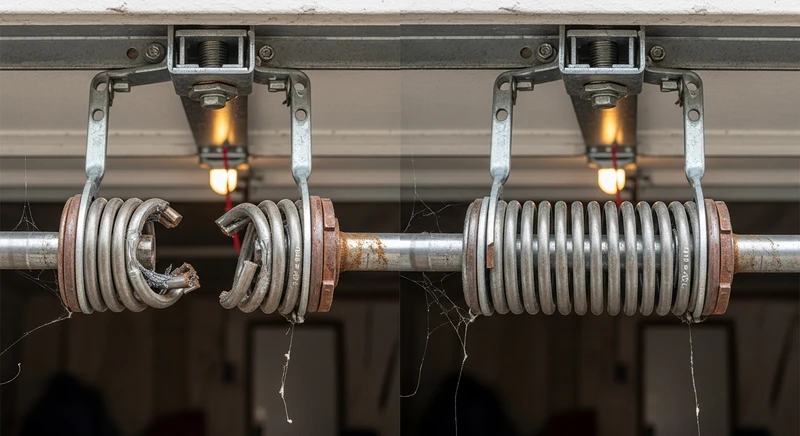
Stretched or Sagging Extension Spring
A healthy extension spring has coils that are evenly spaced and tightly wound. When the spring stretches — which happens as the metal fatigues — the coils spread apart and the spring visibly sags along the track. Once stretched, an extension spring has permanently lost its tension rating and cannot be re-tensioned. Replacement is the only fix. This is especially common in Pasadena homes built pre-1990 where the original extension springs have never been replaced.
Elongated Torsion Spring Coils
Look along the length of the torsion spring. If certain coils appear wider or more spread apart than adjacent coils, those sections have fatigued. The metal has deformed under repeated stress cycles. This is called metal fatigue elongation, and it means failure is imminent — not eventual. Some of these springs will snap within the next 50 to 100 cycles. Don’t wait for the bang.
Cables Hanging Loose or Coiled on the Floor
When a spring breaks, it releases the tension that keeps the cables taut. Without that tension, cables go slack and can pile up at the bottom of the door or hang loose from the drums. This is frequently mistaken for a cable problem. It’s almost always a spring problem with cables as the secondary symptom. Never operate the door with slack cables — they can wrap around the drum or snap under uneven load.
Top Panel Bowing or Bending
When an opener tries to pull a door without a functioning spring, it yanks the top panel upward with no counterbalanced support. The result is the top section of the door bending or bowing inward. This is structural damage to the door itself — expensive to repair, sometimes requiring a full panel replacement. It happens when someone uses the opener after a spring failure. See our Garage Door Installation page for panel replacement options.
Door Opens Only 3 to 6 Inches Then Stops
Modern openers have built-in resistance sensors. When the opener detects the door is heavier than expected — because the spring is broken and the full door weight is on the motor — it stops and reverses as a safety measure. A door that opens 3 to 6 inches and stops is almost always a broken spring, not an opener malfunction. The opener is doing exactly what it’s designed to do: refusing to damage itself by moving a door it can’t safely handle.
Orange Dust or Metal Shavings Below the Spring
Look at the floor directly beneath the torsion spring bar. A small pile of orange or rust-colored dust means the spring’s coils are actively grinding against each other during operation. This is corrosion literally falling off your spring. The metal is weaker than it looks from below. This sign is most common in garages with poor ventilation — which describes a lot of attached Pasadena garages with minimal airflow.
Spotted Any of These in Your Pasadena Garage?
Stop using the door and call (626) 707-0240 — Garage Door Pros can reach most Pasadena and Altadena neighborhoods within two hours, same day.
Is a Broken Garage Door Spring Actually Dangerous?
The short answer is yes. The detailed answer explains why most homeowners underestimate it.
Can the Garage Door Fall If the Spring Breaks?
It can, and it does. Without spring tension counterbalancing the door’s weight, there’s nothing preventing a 200 to 500-pound door from dropping under gravity. Torsion spring failure is especially abrupt — when the spring snaps, the door can drop immediately. Extension spring systems have safety cables that are supposed to catch the spring if it breaks, but those cables don’t hold the door itself — they prevent the spring from becoming a flying projectile. The door can still drop.
A study cited by the DASMA (Door and Access Systems Manufacturers Association) found that garage door-related injuries account for tens of thousands of emergency room visits annually in the U.S., with spring failures being a leading mechanical cause. A door dropping on a person, a pet, or a vehicle is not a minor inconvenience. It is a medical emergency.
Why You Should Never Use the Door After a Spring Breaks
The Opener Motor Overloads
Openers are designed to assist a balanced, spring-counterbalanced door. They are not designed to move a door’s full unassisted weight. Using an opener without a working spring can burn out the motor within a handful of cycles — sometimes within a single use. A LiftMaster 8500 opener that retails for $300+ can be destroyed in minutes.
Cables Snap from Uneven Load
Cables rely on spring tension to stay properly seated on their drums. Without that tension, the cable path changes. Cables wrap incorrectly, fray, and snap. A snapping cable under load can cause the door to drop instantly on whichever side the cable serves.
The Door Can Jump the Track
Without balanced spring tension, the door panels flex and shift unevenly. This causes rollers to pop out of the track. A door that’s off its track mid-travel can fall at an unpredictable angle and at unpredictable speed. Track damage from this scenario can turn a $250 spring replacement into a $600 to $900 track and spring repair.
Who Is Most at Risk
Children and pets who are near or walking under the door during operation. Anyone who manually pulls the emergency release cord on a door with a broken spring — removing the opener from the equation leaves nothing to control the door. Never pull the emergency release unless you are certain you can physically hold the door or you are certain it is fully in the closed position.
A Broken Spring Is a Safety Emergency — Not a Maintenance Item
If you’re in Pasadena, Altadena, Arcadia, or San Marino and you believe your spring has failed — call Garage Door Pros immediately. We’re available 24/7, including nights and weekends, with no extra charge for same-day response in our service area.
Repair vs. Replace — When Does a New Door Make More Sense?
Delaying spring replacement is one of the most expensive decisions a homeowner can make. Here’s exactly what the math looks like when you wait.
| Ignored for | What happened next | What it cost | Early repair cost | Overpaid |
|---|---|---|---|---|
| 1 week Grinding noise |
Spring snapped during morning commute. Car trapped inside garage. | $395 $275 spring + $120 service |
$175 Normal visit, spring only |
+$220 |
| 2 weeks Heavy door |
Spring failed completely, cables snapped from uneven load. | $570 $350 springs + $220 cables |
$250 Spring only, cables intact |
+$320 |
| 1 month Tilting door |
Door jumped track, top panel bent from opener pulling against it. | $1,550 $400 + $300 track + $850 panel |
$250 Spring only, structure intact |
+$1,300 |
| 3 months Opener strain |
Opener motor burned out, spring broke same week. | $725 $450 opener + $275 springs |
$175 Spring only, opener running |
+$550 |
| 6 months Rust spotted |
Spring snapped violently, projectile hit vehicle windshield. | $1,075+ $275 spring + $800 windshield |
$175 Spring only, vehicle safe |
+$900+ |
Real-world cost outcomes from delayed garage door spring repairs. Early repair figures based on 2026 Pasadena standard service rates.
These aren’t worst-case scenarios. These are the calls Garage Door Pros gets regularly across Pasadena. The pattern is consistent: every week of delay after recognizing a warning sign adds between $50 and $300 to the final repair bill — and increases the risk of an injury or property damage event.
Torsion Spring vs Extension Spring — Lifespan and Failure Differences
How Many Cycles Does a Garage Door Spring Last?
A standard residential garage door spring is rated for approximately 10,000 cycles. One cycle is one complete open-and-close movement. If your household uses the garage door four times per day — a modest estimate for a household with two cars — that’s 1,460 cycles per year. At that rate, a standard spring lasts roughly six to eight years. Use it more, and it wears faster. High-cycle springs rated at 25,000 to 50,000 cycles are available and worth the cost for households that use the garage as their main entry point.
A standard residential garage door spring is rated for approximately 10,000 cycles. One cycle is one complete open-and-close movement. If your household uses the garage door four times per day — a modest estimate for a household with two cars — that’s 1,460 cycles per year. At that rate, a standard spring lasts roughly six to eight years. Use it more, and it wears faster. High-cycle springs rated at 25,000 to 50,000 cycles are available and worth the cost for households that use the garage as their main entry point.
Comprehensive Comparison: Spring Types, Lifespan, and Failure Behavior
The comparison below covers all major spring configurations used in Pasadena residential and light commercial garage doors, including cycle ratings, failure patterns, replacement cost ranges, and our recommendation methodology based on door weight, usage frequency, and home age.
| Spring Type | Cycle Life | High-Cycle | Failure Style | Safety Profile | Cost (Pasadena) | Best For | Our Recommendation |
|---|---|---|---|---|---|---|---|
| Torsion — Standard | 10,000 | Yes | Sudden snap, loud bang, visible coil gap | Contained above door header | $175–$275 single $250–$400 pair |
Most homes built after 1990 | Upgrade to high-cycle when replacing |
| Torsion — High-Cycle 25k | 25,000 | Yes | Same as standard but far more warning time | Contained above door header | $225–$350 single $325–$500 pair |
Primary entry, 4+ cycles/day | Best value over 10 years |
| Torsion — High-Cycle 50k | 50,000 | Yes | Gradual tension loss — more warning before failure | Contained, lowest injury risk | $300–$500 single $450–$700 pair |
Commercial, RV, heavy double doors | Best for heavy use or commercial |
| Extension — Standard | 8,000–10,000 | Limited | Gradual stretch and sag; less explosive than torsion | Needs safety cable to prevent projectile | $150–$250 pair | Older homes, low-clearance garages | Acceptable — upgrade to torsion if possible |
| Extension — With Safety Cables | 8,000–10,000 | Limited | Spring contained by cable; door may still drop | Better than without cables | $180–$275 pair includes cable |
Older homes, torsion conversion impractical | Minimum standard for extension systems |
| TorqueMaster (Wayne Dalton) | 10,000 | No | Hidden inside tube — no visual warning | Enclosed system, reduced projectile risk | $200–$350 system | Wayne Dalton doors only | Inspect more frequently — no visual access |
| Galvanized Steel Torsion | 10,000–15,000 | Yes | Corrosion-resistant; longer rust-free life | Same as standard torsion | $210–$325 single | Hills, high-moisture garages | Best for Altadena hillside homes |
| Oil-Tempered Steel Torsion | 10,000–20,000 | Yes | Better stress resistance; more ductile under load | Contained; slightly more ductile under load | $225–$375 single | Heavy doors, 2-car over 16 ft wide | Best material upgrade for heavy doors |
Spring type comparison based on 2026 Pasadena installation data. Cycle life estimates assume average residential use of 4–6 cycles per day.
Methodology note: Pricing ranges reflect 2026 market rates for Pasadena, CA, including parts and labor. Cycle life figures reflect manufacturer specifications under standard residential use conditions. All recommendations account for local climate factors including Santa Ana winds, Pasadena’s temperature range, and typical home construction vintage.
When to Replace Springs Even If They Haven't Broken
Here’s a simple decision framework based on what you’re actually seeing and hearing today.
Not Sure Where Your Spring Stands? We'll Tell You — At No Charge.
Garage Door Pros offers free spring inspections with every service visit across Pasadena. One call and we’ll give you an honest assessment — replace now, replace soon, or you’ve got time. We don’t sell replacement springs that don’t need replacing.
Can You Prevent a Garage Door Spring from Breaking?
You can’t prevent it indefinitely — springs have finite cycle lives by design. But you can significantly extend that life and, more importantly, catch the failure signal early enough to replace on your schedule rather than scrambling for emergency service. Here’s what actually works.
Lubrication — The Single Highest-Impact Step
Apply a silicone-based spray lubricant to the spring coils every three to six months. Do not use WD-40 — it’s a water displacer, not a lubricant, and it breaks down metal over time. Silicone spray reduces friction between coils and dramatically slows corrosion. Pasadena-specific tip: lubricate after every major Santa Ana wind event. Wind-driven debris embeds in spring coils and acts as an abrasive. This one habit, done consistently, can add one to two years to a standard spring’s lifespan.
Monthly Manual Balance Test
Disconnect the opener, lift the door halfway, and let go. It should stay put. Takes 30 seconds. Do it on the first of every month. This simple test catches tension loss before the spring fails — and it’s the same test our technicians perform on every Garage Door Maintenance visit. If you’ve been doing this test and you notice the door is drifting down further than last month, you’re watching your spring lose tension in real time. That’s exactly the awareness you want.
Annual Professional Inspection in Pasadena
A professional spring inspection catches things you can’t see without training: micro-fractures in coils, uneven tension distribution, cable drum wear that stresses the spring indirectly. The annual cost of a professional inspection — included with every maintenance visit from Garage Door Pros — is a fraction of one emergency service call. Consider it insurance with a guaranteed return. We include spring inspection with every Garage Door Maintenance service across Pasadena and the San Gabriel Valley.
Upgrade to High-Cycle Springs
If your household uses the garage four or more times per day — meaning the garage is the primary entrance to your home — standard 10,000-cycle springs are a poor choice. High-cycle springs rated at 25,000 cycles cost roughly $75 to $100 more per spring and last two and a half times longer. Over ten years, you replace springs once instead of three times. The math is simple. Brands like Precision Door have made high-cycle oil-tempered springs their standard offering for exactly this reason.
Always Replace Both Springs at the Same Time
If one spring breaks, the other has lived through the same number of cycles under the same conditions. They were installed together. They’ve worn together. Replacing only the broken spring puts a brand-new spring next to a nearly-worn-out one. The second spring fails within six to eighteen months, and you pay for another service call, another labor hour, and another spring. Replacing both at once costs about 30% more than replacing one — versus 100% more for two separate visits within a year.
Can You Replace a Garage Door Spring Yourself? (DIY Warning)
Search for garage door spring replacement on YouTube and you’ll find dozens of videos making it look manageable. Here’s what those videos don’t show you.
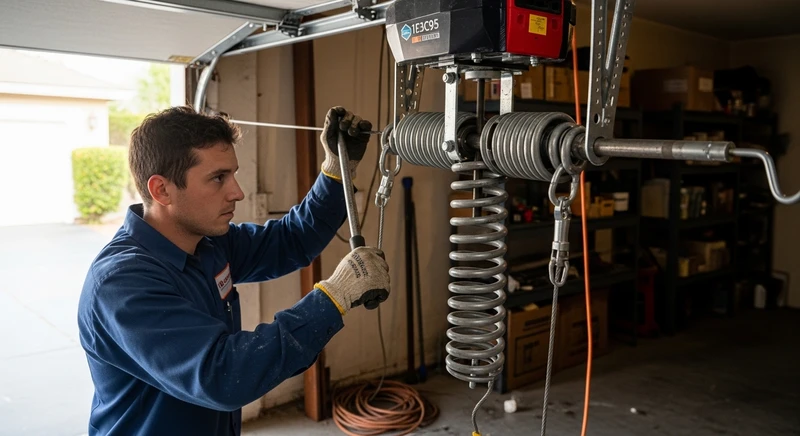
A torsion spring stores between 100 and 400 pounds of rotational force when wound. That energy releases instantly when something goes wrong. The winding bars used to tension the spring — two 18-inch steel rods inserted into the spring’s winding cone — can become projectiles. There are documented cases of winding bars being launched across garages with enough force to penetrate drywall. A spring that unwinds violently during an improper DIY attempt can cause severe lacerations, broken bones, or fatal injuries to the face and head.
The Injury Risk Is Not Theoretical
Garage Door Spring Repair Cost in Pasadena, CA
Pricing in Pasadena reflects both the local labor market and the cost of stocking parts for same-day service. The numbers below are 2026 estimates based on current parts and labor costs in the San Gabriel Valley. Your final price depends on spring type, door weight, and whether secondary damage (cables, drums) needs to be addressed at the same time.
Same-Day Garage Door Spring Replacement in Pasadena
When your spring fails on a Tuesday morning and your car is inside the garage, “schedule an appointment for next week” isn’t a solution. That’s why Garage Door Pros runs with fully stocked trucks — not vehicles that need to stop at a supply house between your call and your driveway.
Here’s what “same-day” actually means at Garage Door Pros: when you call (626) 707-0240, a dispatcher confirms the earliest available technician in your neighborhood. For most Pasadena addresses, that’s a two-hour window or less. The technician arrives with the most common torsion and extension spring sizes, replacement cables, and the tools to complete the job in a single visit. You don’t wait for a part delivery. You don’t get a callback saying they need to order your spring size. You can get more information about the spring replacement service here.
Spring Broken Right Now? We Can Reach Most Pasadena Neighborhoods Within 2 Hours.
Garage Door Pros is local. Our technicians live and work in the San Gabriel Valley. When you call, you’re not routed to a national dispatch center — you’re calling a team that knows Fair Oaks Avenue, knows Bungalow Heaven, and keeps your streets in their daily route. Available 24/7. No hold music. No “we’ll call you back.”
Frequently Asked Questions
What does a broken garage door spring sound like?
A breaking torsion spring produces a loud, sharp bang — many homeowners describe it as sounding like a gunshot or a large firecracker inside the garage. This happens because the spring releases its stored energy instantly as it snaps. Extension springs snap with a similar but slightly less explosive crack. Both sounds are sudden and unmistakable. You may hear the spring break while the door is in motion, while it’s sitting still, or even in the middle of the night. A repetitive popping or clicking sound during operation — as opposed to a single loud bang — is a different symptom: it typically indicates coils cracking or fatiguing under load, which is a warning sign rather than a complete failure.
Can I still open my garage if the spring is broken?
You should not, even if the opener runs and the door moves slightly. Without a functioning spring, your door’s full weight — anywhere from 150 to 500 pounds — is on the opener motor alone. The opener isn’t designed to carry that load. Forcing it to do so can burn out the motor within a single use, snap the cables from the uneven load, or cause the door to jump off its track mid-travel. If the door does move, it will be uncontrolled on the way down. The risk is not worth the convenience.
How do I know if it's the spring or the opener that's failing?
The manual lift test solves this in thirty seconds. Pull the emergency release cord (the red handle hanging from the opener track) to disconnect the opener. Now lift the door manually to about waist height and let go gently. If the door feels extremely heavy — like it’s fighting you — and drops immediately, the spring is the problem. If the door lifts easily and stays where you put it, the opener is likely the issue. Openers that struggle to lift a properly counterbalanced door are almost always working against a weak or broken spring. Replacing the opener without fixing the spring means your new unit struggles with the same door from day one.
Do both springs need replacing at the same time?
Yes, for dual-spring systems. If one spring breaks, the other has logged the same number of cycles under the same conditions. It’s typically within a few hundred cycles of failure. Replacing only the broken spring means a second service call in six to eighteen months, and your door runs slightly unbalanced in the interim — stressing the opener and the surviving spring faster than it would otherwise. Replacing both at once costs roughly 30% more than replacing one. Two separate visits cost 100% more. The math strongly favors doing both at once.
Is it safe to drive under my garage door if I think the spring is failing?
If the door is operating normally and there’s no visible damage, limited use while you schedule service is acceptable — but use it as little as possible and keep it moving. Do not idle under a moving door or stand in the opening while the door travels. If you’ve noticed the door closing faster than normal, slamming, or behaving erratically, stop using it entirely until it’s been inspected. A door with a partially failed spring can drop unpredictably at any cycle.
What to Do Right Now If You Spotted Any of These Signs
You’ve read through ten warning signs, visual indicators, and a failure pattern table. Now the only question is: what did you recognize?
If you saw a gap, heard a bang, or your door is slamming — stop using it today. Call (626) 707-0240 right now. This is a safety situation, not a maintenance schedule item.
If you saw rust, noticed the door feels heavier than it used to, or your opener has been struggling — schedule service this week. The signs are there. The math on waiting is never in your favor.
If you’re not sure — do the manual balance test. Disconnect the opener, lift the door halfway, let go. If it stays put, you’ve got time. If it slides down, you don’t. Either way, now you know.
Garage Door Pros has been serving Pasadena, Altadena, Arcadia, and the full San Gabriel Valley. We don’t do call centers or dispatch contractors we’ve never met. Every technician you get from us is vetted, manufacturer-certified, and background-checked — and your quote is written before any work starts. That’s not a marketing line. It’s how we’ve built our reputation in this neighborhood.
Ready to Stop Wondering and Get an Answer?
Call Garage Door Pros at (626) 707-0240 for same-day spring inspection and replacement across Pasadena and the San Gabriel Valley. Free inspection with every visit. Written quote before we start. No surprises. We’re local — we’ll be there today.